

Bot Services Market to Surge at 29.3% CAGR, Anticipated to Reach USD 48.55 Billion by 2035
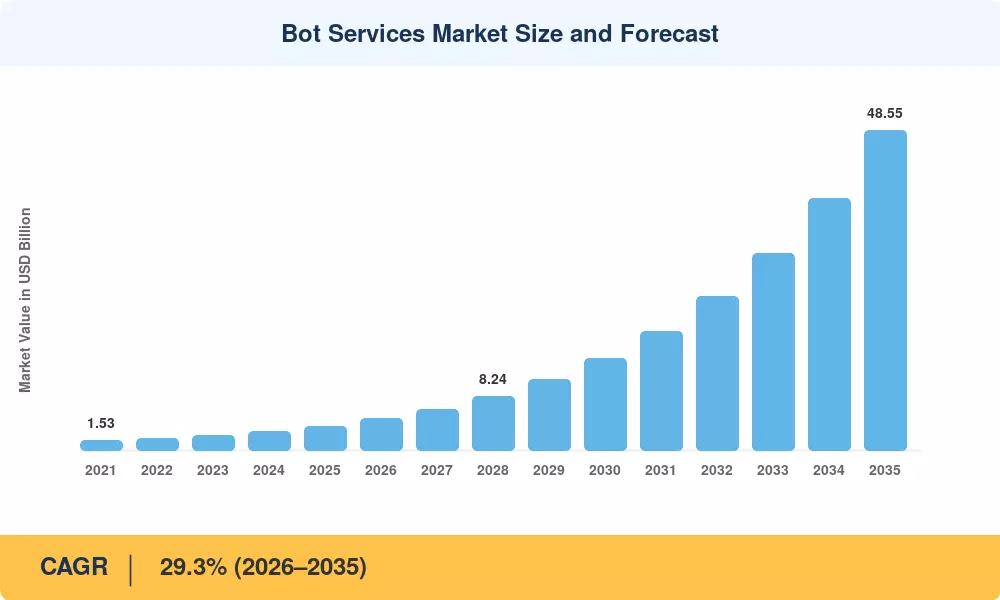
Bot Services Market
Bot Services are transforming customer engagement through AI-powered automation, intelligent assistants, personalized support, and seamless digital interactions
Bot Services are reshaping customer engagement through intelligent automation, personalized interactions, and AI-powered digital experiences.”
NEW YORK(NY), NY, UNITED STATES, September 4, 2026 /EINPresswire.com/ -- The Bot Services Market is rapidly transforming how organizations communicate with customers, automate workflows, and deliver digital services. AI-powered bots can handle routine interactions, provide instant responses, support employees, and improve operational efficiency. Businesses across banking, retail, healthcare, telecommunications, travel, and technology are increasingly adopting conversational solutions to meet rising digital engagement expectations.— Market Research Future
The growing use of artificial intelligence, machine learning, natural language processing, and automation is strengthening demand for intelligent bot platforms. Modern bots can understand user intent, personalize conversations, integrate with enterprise applications, and support multiple communication channels. These capabilities are helping organizations reduce response times while improving service availability and creating more consistent digital experiences.
Enterprise adoption is also moving beyond basic rule-based chatbots toward intelligent conversational agents capable of handling complex requests. Voice interfaces, generative AI, multilingual capabilities, and automated workflow execution are expanding the role of bots across customer service and internal business operations. As organizations prioritize automation and digital-first engagement, demand for scalable bot services is expected to remain strong.
Get An Exclusive Sample of the Research Report at -
https://www.marketresearchfuture.com/sample_request/4688
Market Growth Outlook
The Bot Services Market closed 2025 at USD 3.64 billion and enters its forecast window at USD 4.78 billion in 2026, expanding to USD 48.55 billion by 2035 at a 29.3% CAGR. Two catalysts anchor that trajectory: accelerating enterprise automation and the rapid integration of generative AI into conversational platforms. These developments are reshaping how businesses deliver services.
Organizations are increasingly investing in bot technologies because they can provide continuous support without being limited by traditional operating hours. Bots can manage repetitive inquiries, appointment scheduling, order tracking, account assistance, and basic troubleshooting. This allows human
employees to concentrate on higher-value responsibilities while improving response efficiency and reducing pressure on customer-support teams.
Another important factor is the expansion of omnichannel communication. Customers increasingly interact with organizations through websites, mobile applications, messaging platforms, social channels, and voice interfaces. Bot services can connect these channels through centralized conversational systems, allowing organizations to maintain consistent interactions across different touchpoints while collecting valuable insights from customer conversations.
Artificial Intelligence Driving Bot Adoption
Artificial intelligence is one of the strongest technological forces shaping the Bot Services Market. Machine learning enables bots to improve their understanding of customer intent, while natural language processing allows them to interpret conversational language. Generative AI further enhances these capabilities by enabling bots to produce more natural and context-aware responses.
The integration of large language models is helping bots move from scripted responses toward more flexible conversations. Intelligent systems can summarize information, retrieve relevant knowledge, generate responses, and assist users with increasingly complex tasks. Enterprises are therefore exploring bots not only as customer-service tools but also as digital assistants for sales, marketing, human resources, IT support, and knowledge management.
Enterprise Automation and Productivity
Business process automation is creating substantial opportunities for bot service providers. Enterprises can deploy bots to automate repetitive workflows such as employee onboarding, information retrieval, service requests, scheduling, document processing, and internal support. These applications can reduce manual effort and allow employees to access information more quickly.
The growing availability of cloud-based bot platforms is making automation accessible to organizations of different sizes. Cloud deployment enables businesses to scale conversational applications according to demand without maintaining extensive infrastructure. It also supports faster integration with customer relationship management systems, enterprise resource planning platforms, databases, communication tools, and analytics applications.
Customer Experience and Intelligent Engagement
Improving customer engagement has become a major objective for organizations adopting conversational technologies. Bots can provide immediate assistance, personalize recommendations, answer frequently asked questions, and guide customers through purchasing or service processes. Their ability to operate continuously can also improve service availability and reduce waiting times.
The relationship between bot adoption and customer-centric technologies is becoming increasingly important. Intelligent bots can use customer data and contextual information to create more relevant interactions. When combined with analytics and personalization technologies, they can support stronger engagement strategies and help organizations deliver more seamless digital experiences across multiple customer touchpoints.
Buy this Premium Research Report -
https://www.marketresearchfuture.com/checkout?currency=one_user-USD&report_id=4688
Regional Market Share Analysis
North America accounted for approximately 28.2% revenue share, making it a major regional contributor to the Bot Services Market. Investment is being supported by enterprise AI platforms, conversational automation, voice modernization, and widespread cloud adoption. Businesses in the region are increasingly deploying advanced bots for customer service, employee assistance, sales engagement, and automated workflows.
Europe represents another important regional opportunity, with the supplied regional analysis placing the region at approximately USD 0.95 billion. Investment is increasingly focused on compliance-grade deployments, privacy protection, data governance, and data-residency requirements. Organizations are emphasizing trustworthy AI and secure conversational systems as regulatory expectations around digital technologies continue to develop.
Asia-Pacific is positioned as a high-growth region, with the supplied outlook indicating a 30.4% CAGR from 2026 to 2035. Vernacular language models, mobile-first communication, super-app commerce, and expanding digital ecosystems are encouraging bot adoption. India, China, Japan, South Korea, and Southeast Asian economies offer significant opportunities as businesses expand automated customer engagement.
South America represented approximately 9.6% revenue share, supported by messaging-first customer servicing and fintech onboarding applications. Organizations are increasingly using conversational solutions through widely adopted messaging channels to provide financial services, customer assistance, and digital commerce support. Growing smartphone adoption and online service penetration can further strengthen regional demand.
The Middle East and Africa region is associated with approximately USD 0.31 billion, with investment themes centered on sovereign AI programs and Arabic-language models. Governments and enterprises are exploring localized artificial intelligence capabilities to support digital transformation. Multilingual conversational services can create additional opportunities across banking, public services, telecommunications, travel, and commerce.
Market Segmentation
The Bot Services Market can be segmented according to technology, service type, deployment model, organization size, application, and industry vertical. Technology categories include artificial intelligence, machine learning, natural language processing, speech recognition, and generative AI. These technologies determine how effectively bots understand user intent, process information, and deliver personalized responses.
By deployment, organizations can choose cloud-based, on-premises, or hybrid bot environments depending on security, scalability, integration, and compliance requirements. Cloud-based solutions are gaining popularity because they can support rapid implementation and flexible scaling. Hybrid and private environments remain important for businesses managing sensitive information or operating under strict regulatory requirements.
Key Industry Applications
Banking and financial services are among the important application areas for bot services. Financial institutions can use conversational agents for account assistance, transaction inquiries, product information, onboarding, fraud alerts, and basic financial guidance. Bots can improve service availability while helping institutions manage high volumes of routine customer interactions.
Retail and e-commerce businesses are also increasing their use of intelligent bots. Conversational systems can assist shoppers with product discovery, order tracking, returns, recommendations, and purchase-related questions. Integration with customer databases and commerce platforms allows businesses to create more personalized shopping journeys while reducing customer-service workloads.
Healthcare organizations can use bot services for appointment scheduling, general information, patient navigation, reminders, and administrative assistance. Telecommunications companies can deploy bots for troubleshooting, plan selection, billing inquiries, and service requests. These applications demonstrate how conversational automation can support both customer-facing and operational functions across diverse industries.
Key Market Drivers
The major drivers of the Bot Services Market include increasing digital customer engagement, demand for automated support, rising AI adoption, growing cloud usage, and the need to reduce operational costs. Organizations are looking for technologies that can deliver faster service while handling increasing volumes of digital interactions. Bot services provide a scalable approach to meeting these requirements.
The shortage of skilled employees for repetitive support activities is another factor supporting adoption. Automated systems can handle standardized requests while human workers focus on complicated cases requiring judgment and empathy. This combination of automation and human assistance can improve workforce productivity and create more efficient service models.
Emerging Opportunities
Generative AI represents one of the strongest emerging opportunities for bot service providers. Generative models can help bots understand context, produce more natural responses, summarize conversations, and support complex information requests. Businesses are exploring these capabilities to create more sophisticated digital assistants capable of supporting complete workflows.
Multilingual and voice-enabled bots also provide significant growth potential. Organizations operating across multiple countries require conversational systems that can communicate with users in local languages and dialects. Voice modernization can further expand bot adoption by enabling hands-free customer service, call-center automation, and voice-based enterprise assistance.
Challenges and Restraints
Despite strong growth prospects, bot adoption faces challenges related to data privacy, cybersecurity, integration complexity, inaccurate responses, and user trust. Organizations must ensure that conversational systems protect sensitive information and provide reliable answers. Poorly designed bots can create frustration when they fail to understand customer intent or cannot transfer complex issues to human representatives.
The implementation of advanced AI bots can also require substantial investment in data management, system integration, employee training, and governance. Enterprises must establish clear policies for monitoring bot performance and managing sensitive information. Responsible AI practices will therefore remain important as organizations deploy increasingly autonomous conversational systems.
Recent Trends
A major trend is the transition from traditional chatbots to AI-powered conversational agents. Businesses are increasingly seeking systems capable of reasoning across multiple sources, understanding context, and completing actions instead of simply returning predefined answers. Generative AI and retrieval-augmented architectures are contributing to this evolution.
Another significant trend is the integration of bots with enterprise applications. Modern conversational systems can connect with CRM platforms, help-desk applications, commerce systems, databases, and workflow tools. This allows bots to move beyond answering questions and become active participants in business processes, creating greater value for organizations.
Browse In-depth Market Research Report -
https://www.marketresearchfuture.com/reports/bot-services-market-4688
Future Outlook
The future of the Bot Services Market is expected to be shaped by generative AI, autonomous agents, voice interfaces, multilingual capabilities, and deeper enterprise integration. Bots are likely to become increasingly capable of completing multi-step tasks rather than simply responding to individual questions. This evolution could significantly expand their role across customer service and enterprise operations.
Organizations will increasingly evaluate bot platforms based on accuracy, security, personalization, integration capabilities, and measurable business outcomes. Providers that combine intelligent automation with strong governance and human escalation mechanisms are likely to gain an advantage. As AI becomes embedded into everyday business processes, bot services are expected to remain a key component of digital transformation strategies.
Key Takeaways
The Bot Services Market is experiencing rapid growth as enterprises adopt artificial intelligence and automation to improve customer engagement and operational efficiency. Generative AI, cloud deployment, voice modernization, multilingual communication, and enterprise integration are creating new opportunities. North America remains a major contributor, while Asia-Pacific demonstrates strong long-term growth potential.
The next stage of development will focus on intelligent agents capable of understanding context and completing business tasks. As organizations seek scalable digital engagement solutions, bot services will increasingly connect customer experience, employee productivity, analytics, and automated workflows within unified technology ecosystems.
Frequently Asked Questions
What is the Bot Services Market?
It refers to technologies and services that enable organizations to develop, deploy, manage, and optimize automated conversational bots.
What is the projected size by 2035?
The supplied forecast estimates that the Bot Services Market will reach USD 48.55 billion by 2035.
What is the expected CAGR?
The market is projected to expand at a 29.3% CAGR from 2026 to 2035.
Which region has the largest revenue share?
North America holds the largest supplied regional share at approximately 28.2% of revenue.
Which region is growing fastest?
Asia-Pacific is projected to record a 30.4% CAGR between 2026 and 2035.
How is generative AI changing bot services?
Generative AI enables bots to provide more contextual, natural, and flexible responses while supporting increasingly complex tasks.
Which industries use bot services?
Banking, retail, healthcare, telecommunications, travel, e-commerce, technology, and government are major application areas.
What are the major challenges?
Data privacy, cybersecurity, integration complexity, inaccurate responses, governance, and user trust remain key challenges.
➤➤Explore Regional and Country-Level Reports for the Main Keyword to Gain Deeper Market Insights.
China Bot Services Market-
https://www.marketresearchfuture.com/reports/china-bot-services-market-62004
France Bot Services Market-
https://www.marketresearchfuture.com/reports/france-bot-services-market-62001
Germany Bot Services Market-
https://www.marketresearchfuture.com/reports/germany-bot-services-market-61999
Indonesia Bot Services Market-
https://www.marketresearchfuture.com/reports/indonesia-bot-services-market-62002
Japan Bot Services Market-
https://www.marketresearchfuture.com/reports/japan-bot-services-market-62000
Mexico Bot Services Market-
https://www.marketresearchfuture.com/reports/mexico-bot-services-market-62003
South Korea Bot Services Market-
https://www.marketresearchfuture.com/reports/south-korea-bot-services-market-61998
Uk Bot Services Market-
https://www.marketresearchfuture.com/reports/uk-bot-services-market-61997
Us Bot Services Market-
https://www.marketresearchfuture.com/reports/us-bot-services-market-14983
Market Research Future
Market Research Future
855-661-4441
email us here
Legal Disclaimer:
EIN Presswire provides this news content "as is" without warranty of any kind. We do not accept any responsibility or liability for the accuracy, content, images, videos, licenses, completeness, legality, or reliability of the information contained in this article. If you have any complaints or copyright issues related to this article, kindly contact the author above.
